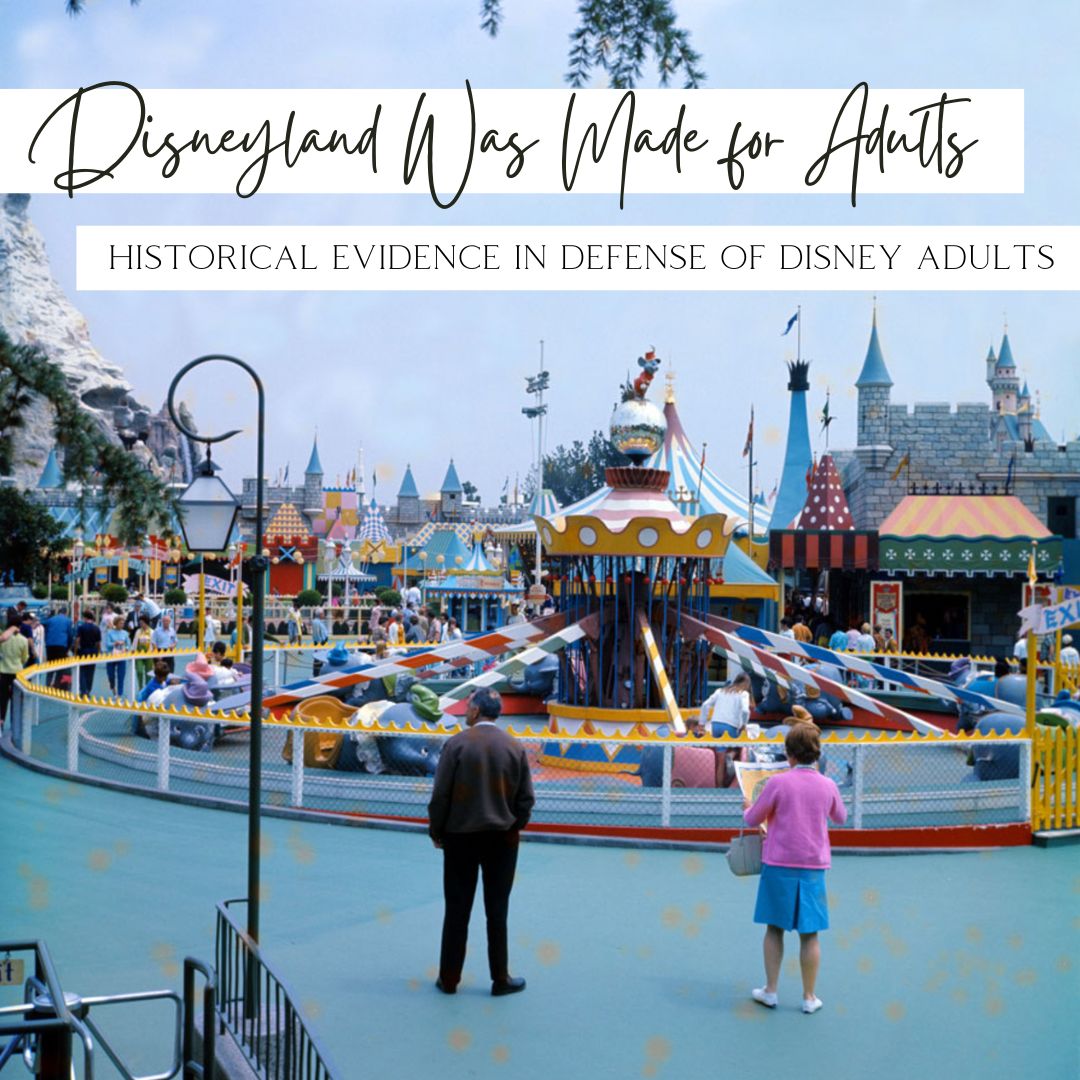
Over the decades I’ve spent as a Disney historian, I’ve heard people say time and time again that there must be something wrong with Disney Adults. Their argument is usually accompanied by the assumption that Disneyland was made for children. But I have historical evidence that proves that Disneyland was, in fact, created for the enjoyment of adults from the very beginning.
At the Cannes film festival in 1953, Walt Disney was once asked by Holocaust survivor Elie Wiesel about his life purpose and the meaning behind his art. Walt’s reply was “Childhood.” He further explained that the purpose of his creation was always to “awaken the childhood of a person, a grown-up person. Because the most beautiful part of a person is their childhood.”

One could argue that Walt was simply referring to his animated films, rather than his theme park endeavors, especially since Disneyland was in early development at that particular time in history. But there is evidence that the new theme park endeavor predicted the popularity with the inner-child part of adults as well.
The pre-opening prospectus from Sept. 3, 1954, created to sell the idea of Disneyland to potential sponsors, predicted that the ratio of children and adult patrons would be approximately 80% adult and 20% children, suggesting that the park was meant to be patronized mostly by those who had reached maturity. But the argument could be made that those numbers were catering to investors, since adults were the ones with money. From a business perspective, it made sense to emphasize that the park was not a kiddie one and that the main demographic was guests with spending power.
But now we come to an article from the Anaheim Gazette dated December 16, 1954. It states, “Disney estimates that only one out of every five visitors will be children, the rest adults longing for an escape back to carefree childhood days. And to all appearances and purposes, Mr. Disney is bent on providing that escape.”

And there you have it, in black and white. Over six months before Disneyland opened its gates, the Imagineers planned for the park to be largely for adults. A place not only where “age relives fond memories of the past,” as Walt Disney said in his opening day speech and dedication of Disneyland, but where childhood itself can be recaptured entirely.
It’s fascinating to me how many people form strong opinions about adults who love Disney without knowing the history of how and why Disneyland was created. Those who assume it’s just for kids or who shame adults for enjoying the park fundamentally misunderstand Walt Disney’s purpose and vision for Disneyland’s existence.
Of course, we all know the story of Walt sitting on a bench in Griffith Park, watching his girls on the merry-go-round and wishing there was a place for parents and children to have fun together. But given the statistics in that prospectus, it’s clear that Disneyland was not made simply for families; it was largely created for adults to be able to reclaim pieces of their childhood.
For a generation that had seen world wars and financial struggle with the Great Depression, Disneyland was a place of hope and healing. Though this particular newspaper article calls it a place of escape, John Hench described Disneyland as a place of reassurance instead of escapism. And I don’t know a single adult who couldn’t use a dose of feeling reassured that everything is going to be okay.

The next time someone says the Disney parks were made for children, and that adults aren’t allowed to enjoy them, show them this article, the historical evidence that proves that Disneyland was, in fact, made for the enjoyment of everyone, ESPECIALLY adults.
Need more Disney inspiration? My latest book So This is Love: What Disney History Teaches Us About Love is now available in audiobook, eBook, paperback and exclusive signed editions in my bookstore here!


